How Long Your Hands Stay Useless After a Cold Plunge (And What to Stage First)
Cold-water research on grip, dexterity and the first five minutes out of the tub — and the short list of things to place before your hands stop working.
You know the moment. The timer goes. You come up over the edge of the barrel, get a foot onto wet concrete, and reach for the towel — and the hand that arrives feels like a hand you're renting. It closes. It just closes late, and badly, and about an inch off from where you were looking.
Then you reach for the coffee.
Two questions are worth answering properly here, and almost nobody does: how long does that actually last, and what should already be sitting within reach before you get in.
The honest headline first. The study you actually want — pegboard and grip dynamometer at one, three, five and ten minutes after a three-minute dunk in 52°F water — does not exist. The cold-hands literature was built for divers, fish processors, offshore rescue and occupational cold work, so almost every protocol is colder, longer, or both. What that literature does give you is the shape of the curve, and the shape is more useful than a single number, because it turns out the shape is counterintuitive in three separate places.
Cold-water physiology is usually taught in four stages, and Mike Tipton's review of the field in Experimental Physiology lays them out plainly: initial immersion (the first three minutes — skin cooling), short-term immersion (three minutes plus — superficial neuromuscular cooling), long-term immersion (thirty minutes plus — deep tissue cooling and hypothermia), and circum-rescue collapse. The same paper notes that "even in ice-cold water, the possibility of hypothermia does not arise for at least 30 minutes in adults."
A 2–5 minute plunge lives entirely inside stage one and the doorway of stage two. That is the whole point and the whole problem. You are not doing anything to your core. You are doing something quite specific to your skin, your superficial nerves, and the tissue closest to the water — and your hands are the part of you most exposed to all three.
Two mechanisms stack. First, geometry: Tipton notes the arms are "particularly susceptible due to their high surface area to mass ratio." Fingers are worse still. Second, your own thermoregulation is actively working against your grip — peripheral vasoconstriction is the body pulling blood away from the hands to defend the core. Your hands are not an accident of the plunge. They are the price the plunge charges.
The cooling has a measurable neurological floor. At nerve temperatures below about 20°C, conduction slows and action potential amplitude drops. Below that, Tipton's review reports, "nerve block may occur after exposure to a local temperature of between 5 and 15°C for 1 to 15 minutes," producing dysfunction "equivalent to peripheral paralysis." Muscle cools too, and the strength penalty is steep: reductions of 4–6% per degree Celsius fall in muscle temperature, down to 30°C.
One aside that this crowd will appreciate, because it explains why the 45°F chest-freezer build doesn't feel proportionally harder than the 52°F barrel: the respiratory cold shock response — the gasp, the ragged first thirty seconds — peaks on immersion in water between 15 and 10°C and gets no greater at 5°C. By the time you're in the fifties, you are already close to a maximal cold shock. Going colder mostly buys you faster tissue cooling, not more gasp.
There is a reflex that would help you, and you never reach it.
Cold-induced vasodilation — the hunting response — is the periodic re-opening of the finger's blood vessels during sustained cold exposure, and it is the reason a long-immersion diver's fingers stabilise instead of continuing to fall. In a 2023 study in the European Journal of Applied Physiology, hands were immersed at 4.3°C and CIVD onset was measured at roughly 12 to 13 minutes — on a first immersion and again on a repeat one.
Twelve minutes. Your session is three.
So you don't step out of a plunge on the plateau. You step out on the descending limb, at or near the coldest your fingers get, with nothing having intervened. Everything the rest of this article describes happens from there.
This is the part people get wrong about their own hands, and it's why they drop things.
A 2020 study in Undersea & Hyperbaric Medicine put twelve subjects through 60-minute head-out immersions in 10°C and 25°C water and tested two kinds of hand function: gross dexterity (the Minnesota Manual Dexterity Test — big pieces, whole-hand movements) and fine dexterity (a modified Purdue Pegboard — small pins, fingertip work). During cold immersion, gross dexterity fell 72% and fine dexterity fell 45%.
Then the interesting result: "Immediately following immersion gross dexterity was recovered in all conditions. Post-immersion fine dexterity was still impaired" in the cold-water condition.
Read that again, because it maps exactly onto what happens on your deck. The big, coarse, whole-hand stuff comes back fast. You can grab a towel and pin it to your chest. You can pull a hoodie down over your head. You can pick up a 40 oz tumbler.
The fingertip stuff does not come back with it. Pinching a lid. Starting a zip. Working a screw cap. Placing a container down onto a narrow, curved, wet surface with the precision that requires. Those are pegboard tasks, and the pegboard is still down when the Minnesota test says you're fine.
That gap is the whole hazard. Your gross function returning is what makes you feel recovered, and it arrives minutes before the function you're actually about to use.
The same study contains one more finding worth sitting with. It also tested a water-perfused suit circulating 37°C water over the torso, arms and legs — active whole-body heating during the immersion. It did not preserve finger temperature and it did not preserve dexterity. Fine dexterity in the heated condition was statistically indistinguishable from the unheated cold condition.
Here is the second counterintuitive bit. Rewarming is not a ramp that starts the moment you exit.
Kingma, Hofman and Daanen, publishing in the European Journal of Applied Physiology in 2018, describe finger rewarming after cold exposure as three phases: "the first phase is a slowly/passive rewarming phase and after about 2 min there is a fast/active rewarming phase. Then there is a final phase where the temperature of the fingers oscillates around baseline temperature." After a ten-minute hand immersion in near-freezing water, mean finger temperature climbed 18.1°C over the following 19 minutes — an average of about 0.9°C per minute, but front-loaded with a flat, slow opening.
So the window in which your fingers are at their least functional is not the moment you're still in the tub, gripping the rim with both hands and nothing to do. It's the ninety seconds to two minutes after, when you are standing on wet concrete, dripping, reaching for six different objects in sequence, with your fingers still on the flat part of the curve.
Grip strength follows a similarly stubborn timeline. Vincent and Tipton, in Aviation, Space and Environmental Medicine in 1988, ran volunteers through five intermittent two-minute immersions in 5°C water and measured maximal voluntary grip strength down 16% after hand immersion and 13% after forearm immersion. Douris and colleagues, in the Journal of Strength and Conditioning Research in 2003, immersed the dominant arm in 10°C water for 5, 10, 15 or 20 minutes and measured grip immediately after and at 5, 10 and 15 minutes — and found a significant decrease "with no recovery of this strength loss for a period of 15 minutes following removal from the cold immersion."
Both protocols are colder and longer than a home plunge, and I'm not going to pretend otherwise. A single three-minute dip at 52°F should cost you less than five two-minute rounds at 41°F. What transfers is not the magnitude — it's the two structural facts: the deficit is real and measurable, and it does not resolve on the timescale people assume while they're standing there feeling fine.
The third counterintuitive finding is the one that ties the other two together, and it's recent.
Chapman and colleagues, in Physiological Reports in 2025, tested fourteen adults through roughly 130 minutes of light-to-moderate work in 20°C, 10°C and 0°C air, running dexterity tests at five points, then gave them ten minutes of passive rewarming at around 22°C and tested once more. On the cooling side, dexterity decrements began at skin temperature thresholds of about 22.9°C at the fingers and 24.9°C at the hand. After the rewarming period, the finger threshold moved up, to about 25.7°C. The hand threshold moved up too, to about 27.1°C — though that one only surfaced in the absolute-time analysis and not in the percent-change one, so lean on the finger number.
Thermal hysteresis. The same skin temperature buys you less dexterity on the way back up than it did on the way down. Your hand can be objectively warmer than it was at the moment your dexterity first started degrading, and still be degraded.
Practically: the moment your fingers stop hurting is not the moment they start working. The sting fading is the signal most people take as the all-clear, and it arrives early.
Two other things are happening in the same window. Shivering, first — and it doesn't degrade what you'd expect. Meigal and colleagues, in Acta Physiologica Scandinavica in 1998, tested force-control accuracy at the hand, elbow and shoulder during shivering: hand grip and elbow flexion held up, but accuracy at the shoulder declined, since proximal muscles shiver harder. Which means the thing shivering costs you isn't the grip. It's the aim. Setting a full tumbler down on a specific spot is a shoulder-and-elbow trajectory before it is ever a finger task.
Afterdrop, second. Cold-water swimmers have known this longer than the plunge scene has existed: you keep cooling after you get out. The Outdoor Swimming Society's guidance puts it as bluntly as anyone — "you are likely to feel colder 10 minutes after you get out from a winter swim than you do the moment you exit." Swimmers' own accounts commonly put noticeable onset around four to five minutes after exit. Your plunge is far shorter than a winter sea swim and the effect scales accordingly, but the direction is the same: minute six is not better than minute one across the board. The OSS's other line is worth carrying to a cold garage too: "It is not recommended anyone drive themselves if cold – it is likely to impair function. Shivering is a sign you are not ready to drive."
Stated as honestly as the evidence allows, for a 2–5 minute session in 39–59°F water:
And the piece of that which actually changes anything: nothing in this literature shortens the impairment once it has happened. Vincent and Tipton's glove condition is the one people assume runs the other way. It doesn't: pulling a glove onto a hand that had already cooled produced a further significant grip reduction averaging 14%, and the authors are explicit that "these reductions were in addition to those caused by hand cooling." Their conclusion is that hand and forearm protection matter for maintaining grip — which is a point about wearing the protection before the cooling, not about reaching for it after. The 2020 diving study points the same way from the other end: heating the entire torso, arms and legs with 37°C perfused water during the immersion didn't preserve finger temperature or dexterity. Neither study tested actively rewarming a hand once you're out, so I can't tell you that nothing would work. I can tell you nobody has shown it, and that the two insulating moves anyone has tested didn't buy the time back.
Which leaves exactly one lever you can actually pull. You can only reduce what you're asking your hands to do while the deficit lasts.
That is a staging problem, and staging happens before you get in.
The organising rule: anything you'll need in the first ten minutes out has to be placed while your hands still work, and placed so it can be operated with a whole hand rather than fingertips. Sort your kit by fine-motor demand and deal with the expensive items in advance.
The towel or robe. Gross task, no preparation required beyond geography. Unfolded and hanging, within one step of where your feet land. Not in a bag, not folded — unfolding a towel is fine, working a bag zip is not.
Clothes, laid out in the order they go on. The Outdoor Swimming Society's post-swim sequence is unhurried and specific — dry off, get dressed without delay, layer up with thermals, jumper, jacket, hat and gloves, and stand on something while you change. Do the fine-motor work now: start every zip so it only needs pulling, skip buttons entirely, and choose slip-on footwear over laces. A zip pull you have to start with numb fingertips is a pegboard task at the exact minute the pegboard is down.
The timer. Start it before you get in and set the screen to stay awake. Cold, wet, vasoconstricted fingertips are unreliable on capacitive glass, and a wet screen doesn't help. If your routine depends on tapping a phone at the two-minute mark, it depends on the one input method the cold specifically degrades.
Keys, and the decision not to drive yet. Put them where you'll see them, and take the shivering rule seriously in a garage as well as on a beach.
The drink. This is the awkward one, because it's the only item on the list that is both fine-motor demanding and wanted immediately.
A short, honest detour on why. You'll see post-plunge rehydration urged fairly hard in this scene, on the back of cold and immersion diuresis. Immersion diuresis is real — in a classic head-out immersion study in The Journal of Physiology, urinary flow rose from about 1.2 to 7.2 ml/min — but that peak arrived during the second hour of immersion. A three-minute dunk is not a dehydration event, and I'd rather say so than sell you a physiological emergency you don't have. The real reasons to have a drink staged are simpler and hold up better. A warm drink is a fixture of every serious cold-water community's post-immersion routine — the Outdoor Swimming Society lists "sip a warm drink" in its warming sequence while cheerfully conceding that "the scientists say the small volume of a hot drink has absolutely no effect on your core temperature, but even if the effect is psychological, it seems to work for us." That's a fair description of what the drink is for. It is also, unavoidably, an object you have to pick up, hold and put back down inside the five minutes when your hands are at their worst. That's not a hydration problem. It's a handling problem.
Handling problems have handling answers:
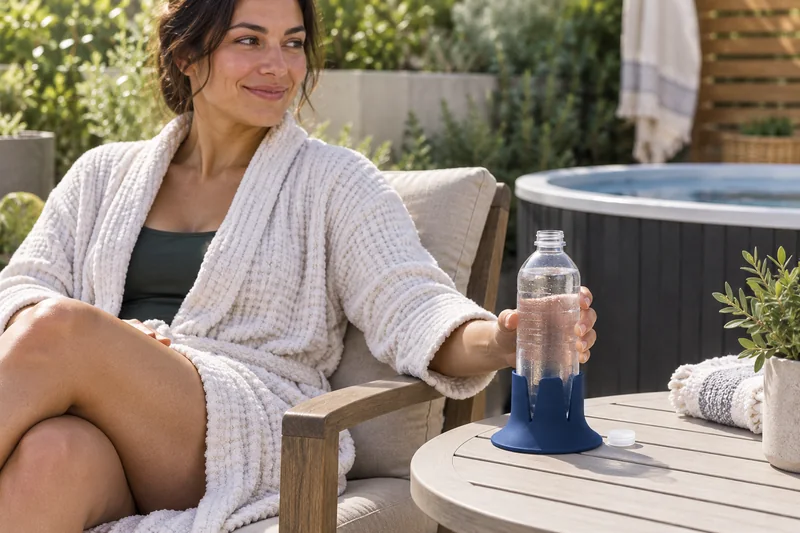
This is the one point in a cold plunge routine where the Steadi base actually has a job, so here's the honest version of it. It's a single piece of Shore 85A TPU, 5.2 inches across at the base and 2.8 inches tall. The base is fixed — it doesn't expand or deform — and the fins flex to grip the bottom inch of the container. The mechanism is only geometry: the fixed 5.2 inch base widens the base of support, so the container's centre of mass has to travel further horizontally before it passes outside that base, which means tipping requires a much larger tilt than the container's own footprint allows. The TPU's tack resists sliding on wet concrete or a wet deck board. And it suits cold hands specifically because the container drops in from above — no grip, no twist, no fine placement asked of you.
The limits matter as much as the mechanism here, given where you're standing. It sinks; it does not float, so it belongs on the deck or the floor, never balanced out over the water. A narrow curved barrel rim is a bad placement for it for exactly the same reason it's a bad placement for the bottle. It needs level bearing, so sand, gravel and grass are out. Handled camp mugs are an honest no — the handle sits where a fin needs to go, which rules out half the mugs at a group polar plunge. It isn't a mount, a clamp or a restraint, it doesn't insulate or seal, and a direct hard knock still wins. It's dishwasher safe, molded in Orange, California, and patent pending. There's a 90-day guarantee from delivery with free returns, and used is fine — which is the only sensible way to buy something whose whole claim is about what happens on a wet floor.
Your hands aren't useless. They're imprecise, and they're imprecise for longer than they feel imprecise, starting from a worse point than you'd guess because a plunge ends before your circulation gets around to defending your fingers.
You can't fix that on the deck. A glove pulled on after the fact costs you more grip rather than giving it back; heating your whole body during the immersion doesn't preserve it either. The only move available is upstream: put the fine-motor work — the zips, the lids, the timer, the placement of the drink — on the side of the session where your hands still work.
Do that once, properly, and the plunge stops ending in a scramble.
How long until my grip is back to normal after a cold plunge? Longer than it feels. In the nearest measured protocol — the dominant arm in 10°C water for 5–20 minutes — maximal grip strength had not recovered at 15 minutes post-immersion. A shorter, warmer home plunge should cost you less, but the recovery is slower than the sensation of warmth suggests.
Why can I carry a towel fine but fumble a bottle lid? Because gross and fine dexterity recover on different clocks. In cold-water immersion testing, gross dexterity had recovered immediately on exit while fine dexterity was still significantly impaired. Whole-hand tasks return first; fingertip tasks lag.
Does the hunting response (CIVD) help during a plunge? Not in a typical session. Measured CIVD onset in 4.3°C water was around 12 minutes. A 2–5 minute plunge ends well before it.
Will warming my hands right after help? No study here tested it directly, so treat confident answers with suspicion. What has been tested: gloving a hand that had already cooled produced a further 14% grip reduction on top of the cooling rather than recovering it, and active whole-body heating during immersion failed to preserve finger temperature or dexterity. Passive finger rewarming is itself flat for roughly its first two minutes. Prevention and staging are the parts you can rely on.
Should I be worried about hypothermia in a 3-minute plunge? That is not the risk profile of a short session. Even in ice-cold water, hypothermia doesn't arise for at least 30 minutes in adults. The risk in a short plunge is incapacitation and the fall, drop or slip that follows from it — which is a staging and footing problem, not a core temperature one.
Buying happens at steadilabs.com — the company that molds it.